A Review and Comparative Analysis of Various Encryption
Research Article, Jceit Vol: nine Issue: 3
Comparative Analysis of Encryption Algorithms Against Text Files
Nidhi Girish*, Pranav B, Swetha S and Chethana Murthy
Department of Informatics and Engineering, RV College of Engineering, Bengaluru
*Corresponding Author: Nidhi Girish
Department of Computer science and Engineering, RV College of Engineering, Bengaluru
Tel: +91 9886364400
E-mail: [electronic mail protected]
Received: May xix, 2020 Accepted: July 24, 2020 Published: July 31, 2020
Commendation: Girish Northward, Pranav B, Swetha S, Murthy C (2020) Comparative Analysis of Encryption Algorithms Against Text Files. J Comput Eng Inf Technol 9:3. doi: 10.37532/jceit.2020.ix(three).226
Abstract
The proliferation of technology and vast amount of information transferred every twenty-four hour period has made it imperative to practice security measures to protect people and their information. This issue has been handled by the implementation of cryptography in exchange of data. However, there be many algorithms that can be used to encrypt and decrypt information and choosing the right one for a specific job is crucial. This paper focuses on effectively comparison 4 pop encryption ciphers, namely RSA, DES, Triple DES and Blowfish, through a web application that allows for measuring various factors of encryption, to provide a graphical upshot of the best algorithm to use for encrypting text files.
Keywords: Cryptography; Encryption; Symmetric; Asymmetric; DES; Triple DES; RSA; Blowfish; Key.
Introduction
Basic Terms
Plaintext: Plaintext is a phrase used in information security (cryptography) that indicates to a message before the process of encryption or decryption. That is, it is a bulletin in an arrangement that is straightforwardly understood by humans.
Encryption is the course of obscuring the given letters to make them incomprehensible in the deficiency of some special knowledge. It is commonly done for security purpose, and largely done for very confidential communications. It is also designed for authentication (that is, the course of authorizing the identity of a item individual). The decryption process is the exact opposite of the encryption process, that is, the translation of encrypted data into plaintext or the original text.
Plaintext should never be misunderstood with plain text. Plain text refers to the text consisting completely of characters that are mainly used in near of the written human language. The Plaintext is written with sequences of multiple bits that practice non symbolize human readable characters. Plaintext is mostly written in plain text.
Cipher text: Cipher text is the encrypted text modified from the plaintext using various encryption algorithms. Cipher text cannot exist read without a key until it's been converted back into plaintext (decrypted). The decryption aught is an algorithm that alters the nix text into plaintext.
Key: A cryptographic key is a prepare of string of bits utilized past a cryptographic algorithm to remodel plain text into cipher text or the other mode effectually. This key remains confidential and ensures a very secure communication.
A cryptographic primal is the heart of any cryptographic operations. Many of the cryptographic systems include a set of various operations, like encryption and decryption. A primal is a component of the variable data that'south provided as i of the inputs to a cryptographic algorithm to execute this kind of operation. In an efficiently designed cryptographic scheme, the protection of the scheme depends on the protection of the keys used.
Symmetric Encryption
This is the simplest and the easiest kind of encryption. Symmetric encryption is a cryptographic process where an individual key is responsible for all encryptions and decryptions. The involved parties, that is the receiver and sender, share a unique key, password, or passphrase, to decrypt or encrypt the messages they adopt. Some of the near popular and famous algorithms that are in employ even today, have been categorized as symmetric cryptography, including DES (Data Encryption Standard), Triple DES and AES (Avant-garde Encryption Standard). The former two accept been considered for the purpose of this project and they are very close in operation.
Disproportionate Encryption
This uses pair of keys. The Disproportionate encryption is also a type of crypto-system where in the encryption and decryption processes are accomplished using a pair of unique keys, namely, a public key and a private key. Therefore, this method is otherwise known equally publickey encryption. Asymmetric encryption focuses on the conversion of plaintext into cipher-text utilizing either one of the ii keys that are available (that maybe public or private cardinal) forth with an encryption algorithm. Using the other cardinal (public or private key) along with a decryption algorithm, the original plaintext is regained from the encoded null text. The most popularly disproportionate encryption crypto-organisation is RSA which is widely used and popular [1].
Encryption Algorithms Implemented
For the purpose of this projection, iv well known algorithms were used which are detailed below.
DES: It is the most popular pick of encryptfion algorithm and it was formulated on Data Encryption Standard (DES) which was developed in 1977 by the National Agency of Standards. The DES algorithm in itself is called as the Data Encryption Algorithm (DEA). In this algorithm, the plaintext is encrypted in a series of 64-bit blocks with the help of a 56-fleck fundamental. It takes a series of 64-bit input data and transforms it into blocks of a 64-bit output. The steps that are followed in the encryption procedure with the aforementioned central of that of the receiver, are implemented to reverse the encryption on the encryption side. The DES algorithm relishes a large and a broad spread use all over. DES has besides been the victim of many controversies regarding the security the DES provides.
It is a symmetric block nada that encrypts and decrypts the data using a 56-bit key. DES takes a 64-bit cake of plaintext as the input and information technology results in 64-bit block naught text as output [2]. This cipher text is produced by repeating the main algorithm sixteen times, which includes permutation and exchange in each round. It is known that the more the number of rounds, there is an increase in corporeality of try needed to notice the key using Brute Force method. This makes DES a potent cipher in this aspect.
As mentioned above, the DES algorithm uses a 56-bit key for encryption. In reality, initially is when the key is generated. The central comprises of 64 bits and fifty-fifty earlier the algorithm'southward procedure begins, the cardinal size is reduced to 56 bits by discarding every 8th bit of the key to get in a 56-bit key. To accomplish this, the subsequent scrap positions in the key 8, xvi, 24, 32, 40, 48, 56 and 64 are removed and hence, the 56-bit key is created.
The DES algorithm is predicated on ii basic and important features of cryptography: the first feature being substitution (also called defoliation) and the second, transposition (also called diffusion). Information technology involves a serial of 16 similar steps, every step in the procedure is titled every bit a round. Each of the rounds execute the above steps of substitution and transposition.
Triple DES: Every bit mentioned higher up, DES algorithm uses a series of 56 scrap keys to encrypt each block of apparently text. The drawback is that DES tin easily exist deciphered with the help of modernistic technologies. To prevent hackers from dandy into systems the double DES and triple DES were adult which are much more secure than that of the original single DES. This is because of the fact that the double and triple DES uses 112 and 168 bit keys respectively.
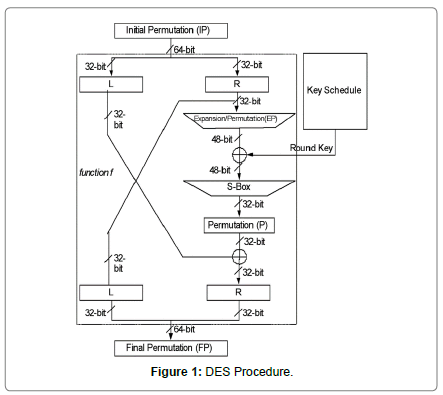
Figure i: DES Procedure.
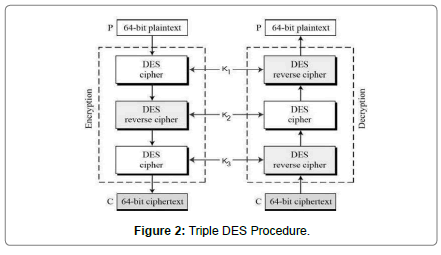
Figure ii: Triple DES Procedure.
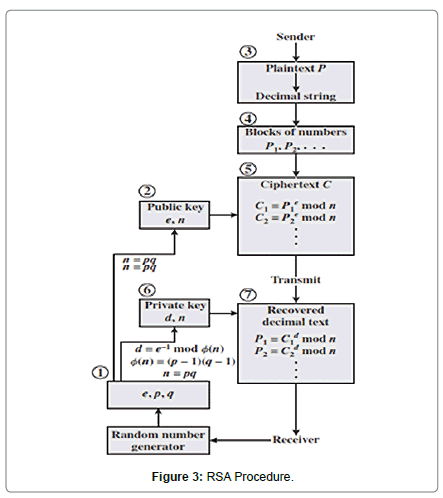
Effigy 3: RSA Procedure.
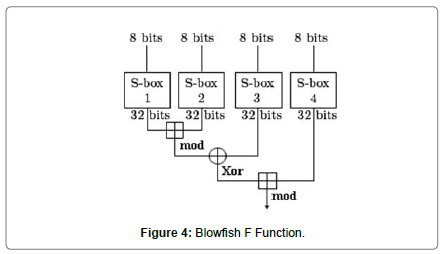
Effigy iv: Blowfish F Part.
While using triple DES, the user first has to generate and issue a triple DES key One thousand, which comprises of 3 diverse DES keys K1, K2 and K3. Past doing and then the triple TDES key has length of 3×56 = 168 bits. To attain the post-obit the plaintext block has to encrypted with the key k1, so the output of the previous has to be decrypted with k2,and that output has to exist encrypted with k3, by following the in a higher place process information technology gives rise to the cipher text. For the decryption process the exact opposite has to be followed of that of the encryption process that is decrypt with k3, encrypt with k2 and then finally decrypt with k1 this results dorsum to the plaintext.
RSA: The RSA algorithm was initially adult and divers in the year 1977 by Ron Rivest, Adi Shamir and Leonard Adelman of (MIT) [3]. Information technology is an algorithm that is used by many modern computers for encryption and decryption of the letters. RSA is categorized every bit an asymmetric cryptography algorithm. The RSA algorithm is presently used in as many as 100's of different software products and this algorithm can exist used for various things such every bit digital signatures, central exchange, or encryption of pocket-sized information. In the RSA algorithm, either the private or the public key tin be used for the encryption of a bulletin, for the decryption procedure the other key from the one chosen to encrypt a message should be used to decrypt the message. The RSA algorithm gets all of its security value from factorization of very big integers that are obtained by the product of the ii extremely big prime numbers. Many popular protocols such as SSL/TLS, S/ MIME, OpenPGP, and Secure Shell operate and solely depend on the RSA for digital signature functions and encryption.
The primary security of RSA is determined by on the two strong suits of split up functions. The RSA algorithm is the nigh prevalent in public-key cryptosystem strength of which is grounded on the practical struggle of factoring the very huge numbers.
Encryption Function − information technology's considered as a i-way function of translating of the plaintext into naught text and it may exist translated back only with the knowledge of personal key or also known as the private key.
Fundamental Generation − the issue of determining the individual key from an RSA public cardinal is alike to factoring the various modulus. A hacker thus cannot use his knowledge of an RSA public fundamental to piece of work out an RSA private key unless he can factor. Information technology's also a 1-way function, from p & q values to modulus northward is straightforward but the reverse isn't possible.
If either one of those two functions are shown non one-way, and then RSA are broken. In fact, if a method for factoring efficiently is developed then RSA will non be safety.
Blowfish: Designed by Bruce Schneier in 1933, this algorithm uses keys ranging from 32 to 448 bits. Its main purpose was to serve equally an alternative to DES [4]. It has the well-known 16 round Feistel Structure, and operates on Southward-boxes which depend on large keys. It's large primal size and range makes the cipher increase its strength and opportunities of use [v].
Methodology
The idea behind this project is to find the all-time encryption algorithm to encrypt text files taking into account four of the virtually popular software and hardware cryptographic algorithms, namely DES, Triple DES, RSA and Blowfish.
Primarily, the analysis was classified into two categories, as discussed below.
Theoretical Analysis
Cryptographic algorithms are preferred based on their forcefulness. This is divers and is according to diverse factors that determine the amount of endeavor needed to suspension the zero and remember plaintext form encrypted text. As a part of theoretical comparative Assay, we looked into 8 different parameters that assist differentiate between the four Encryption and Decryption ciphers. The parameters are:
• Evolution: Who developed the algorithm and when did it go public.[6]
• Key length: The length of key used past the cipher in each round.
• Rounds: The number of times the primary function was repeated.
• Block Size: Size of the input cake of text in bits [7].
• Encryption Ratio: Ratio of the Size of the encrypted role to the whole data size.
• Security Level: How impenetrable is this cipher determines its security level with adequate to high being the range.
• Attacks Establish: Attacks that are successful against the corresponding cypher. [eight-10]
Practical Analysis
• The Encryption algorithms were implemented in python and incorporated to a Django-based Spider web Application.
• It allows for the user to upload a text file and run the four encryption algorithms confronting information technology separately, retrieving the time taken to encrypt the text in the given text file.
• The times for encryption for each of the ciphers against text files of ten different sizes was noted and compared.
Results
The project efficiently differentiated betwixt DES, Triple- DES, RSA and Blowfish. The Theoretical analysis yielded results as described in Table 1.
| Parameters | Algorithms | |||
|---|---|---|---|---|
| DES | Triple DES | RSA | Blowfish | |
| Development | 1970 by the company IBM and was Published in 1977 | IBM in the twelvemonth 1978 | By three people Ron Rivest, Shamir & Leonard Adleman in 1978 | Bruce Schneier in 1993 |
| Key length | 56 bit cardinal | 112,168 fleck key | variable primal length, depends on the no. of $.25 in the module | Variable key length |
| Speed | Very Ho-hum | Slow | Moderate | Very Fast |
| Rounds | 16 | 48 | i | 16 |
| Cake Size | 64 | 64 | variable size | 64 |
| Encryption Ratio | Loftier | Moderate | High | High |
| Security Level | Adequate | Adequate | Good | High Security |
| Attacks found | Differential analysis, Linear cryptanalysis | Related cardinal attacks | Timing set on | No attacks are institute to exist constructive |
Table 1: Theoretical Analysis of DES, Triple- DES, RSA and Blowfish.
With respect to the Evolution methods, both DES and Triple DES found their start at IBM while the other two algorithms were not developed by an system. Uniquely, Blowfish is credited to a unmarried individual whereas RSA was founded by a team of three.
Fundamental length of each null is a deciding cistron to its forcefulness and usability. In this project, all iv algorithms being considered take different cardinal lengths. RSA and Blowfish has variable wavelengths depending on the size of plaintext or cipher text given as input, while DES has a fixed 56 bit key. In the case of Triple DES, depending on whether the user wants to repeat keys, 112 flake keys or 168 flake keys tin can be used.
The speed of the ciphers that is expected is, DES and Triple DES are the slowest among the iv algorithms. RSA is seen to be faster than the previous two, simply Blowfish has been observed to be the fastest amongst the four, with a college throughput capacity.
The basic idea behind rounds is that it is a complete unit of encryption or decryption operations practical on plaintext or nil text respectively. This unit is repeated a given prepare of times to ameliorate the force of the function being applied on text. Out of the 4, RSA does non follow this procedure, as information technology is involves executing a serial of mathematical functions at in one case. This brand it valid to count the number of rounds of encryption in RSA as one. However, DES and Blowfish employ xvi rounds, while Triple DES has the highest number, leading at 48 rounds.
3 of the ciphers have a fixed 64 scrap block size, just RSA allows for variable length of text equally input for the algorithm. This allows for RSA to be more convenient to use, without requiring the plaintext or goose egg text to be modified earlier applying the algorithm.
Encryption Ratio proves as an important parameter as it defines the speed at which the data can be transmitted after encryption, compared to the speed of the original data transmission. In this case, but Triple DES has a decent rest between the length of zip text for the length of plaintext encrypted. The other three algorithms unremarkably event in a larger zip text compared to the plaintext.
Security Level, expressed in "bits", normally defines the exponential value with base 2 operations necessary to crack the cipher using creature force. Blowfish succeeds in this regard, with a very high 'n' bit value, followed by RSA and with Triple DES, DES coming in 3rd.
The attacks that have been successful against the iv ciphers respectively have been listed in Table one.
The Practical Analysis was conducted in a series against files of x different sizes. In an ascending social club, the ciphers were run against each file, with their execution times noted down. Finally the throughput was calculated in MB/2d to derive the following results, described in table 2.
| Input Size(KB) | Time taken to encrypt (s) | |||
|---|---|---|---|---|
| RSA | 3-DES | DES | Blowfish | |
| ix KB | 0.026 | 0.059 | 0.023 | 0.089 |
| 28 KB | one.88 | four.36 | 0.785 | 0.v |
| fifty KB | two.49 | 7.43 | one.29 | 1.01 |
| 83 KB | iv.1 | 12.08 | 2.24 | ane.96 |
| 154 KB | 9.73 | 21.7 | 4.66 | iii.15 |
| 279 KB | 16.87 | 38.29 | viii.96 | 5.84 |
| 558 KB | 31.42 | 59.07 | 17.01 | 10.76 |
| 837 KB | 52.44 | 84.85 | 33.63 | fifteen.89 |
| 1022 KB | 67.03 | 104.three | 59.25 | 23.09 |
| 1952 KB | 134.58 | 199.65 | 116.36 | 46.34 |
| Throughput | 1.43 MB/due south | 0.87 MB/s | i.92 MB/south | iv.26 MB/southward |
Tabular array 2: Applied Analysis of DES, RSA, 3-DES and Blowfish.
Conclusion
It can be inferred from the practical analysis that amid the symmetric ciphers, Blowfish has the highest speed. Given the understandable number of rounds in iii-DES, it is the slowest cipher. However, by paying attention to the theoretical analysis, it is confirmed that 3-DES is to the lowest degree piece of cake to fissure, making it very condom for communication, if compromise of fourth dimension efficiency is adequate.
References
- Mohit M, Rajeev B, Amritpal S, Tejinder S (2013) "Comparative Analysis of Cryptographic Algorithms"ane: 2-four.
- Rajdeep B, Rahul H (2015) "Review and Comparative Analysis of Various Encryption Algorithms" 4.
- Agarwal M, Mishra P (2012) "A Comparative Survey on Symmetric Key Encryption Techniques".
- Sunil Kumar South, Aja K (2104) "Performance Analysis of Symmetric Encryption Algorithms for Mobile ad hoc Network".
- Amritpal Southward, Mohit M, Baljinder S, Sandeep Southward (2013) "Comparative Written report of DES, 3DES, AES and RSA".
- Hemangi Z, Savita S (2017) "Comparative Analysis of Various Encryption Algorithms and Techniques", IJRASET.
- Institute Past William Stallings (2005) "Cryptography and Network Security Principles and Practices" Institute By William Stallings, Fourth Edition.
- Atul Thou (2008) "cryptography and network security", Tata McGraw-Hill publishing company, New Delhi.
- Asir Antontony D, Gnana S, Priyadharshini R (2016) "Performance Analysis of Information Encryption Algorithms for Secure Data Transmission".
- Diffie Due west, Hellman E (1976) " New Directions in Cryptography".
Source: https://www.scitechnol.com/peer-review/comparative-analysis-ofencryption-algorithms-againsttext-files-he2o.php?article_id=11544

Postar um comentário for "A Review and Comparative Analysis of Various Encryption"