Color Guard Stained Glass Road Insiide of a Circel Art
There is i quote by Piet Mondrian which could be used to define De Stijl in ane judgement alone: "All painting – the painting of the past as well as of the present – shows us that its essential plastic means were only line and color." Since you probably know at least some of his works, information technology goes without saying that the artist meant this quite literally. We are non going to reduce this article to a single sentence though, as it would foreclose you from knowing a beautiful story about art and its power, told in a language of a style that, due to its alleged rigidness, appeared to be the least "poetic" of all. De Stijl, which ambitiously means The Fashion, was conceived in 1917 in holland by a grouping of artists who centered around the idea to fathom the purity of course and the reality of nature, supposedly obscured by figuration. Having the fourth dimension of its inauguration in mind, it should exist articulate that this urge to redefine, or even reinvent reality comes from a feeling of feet and disappointment caused past the Starting time World State of war. They believed at that place had to be something more to life than what was being served, but in visual terms, this "something more" was actually achieved by reduction and simplification, rather than embellishment.
Just similar the cubists had the capacity to see things through abstract shapes combined, and the futurists saw a single movement in all of its stages, the protagonists of De Stijl – specially painters – were inclined to understand nature as a combination of relationships, rather than of bodily concrete forms.
This "way", or rather a school of thought, is called Neoplasticism - the new plastic art, which aimed to develop a universal linguistic communication that gradually gave ascent to Modernism. Their visual expression was radicalized by a self-invented vocabulary that functioned according to its ain organisation, consisting of orthogonal lines and primary colors as the most basic tools for not-verbal communication. These elements are sometimes wrongly interpreted as shapes, which they plain are, merely it is not what they aim to represent. The thought was non to repeatedly paint red, white, blue and xanthous rectangles outlined with black lines in order to discuss their mere advent, but to capture the sensations that come up through our eyes, and to interpret them into the domain of the cognitive. In other words, Mondrian'southward art is not about the crimson and the blue, it is about the redness of cherry-red, the blueness of blueish, which cannot be mistaken one for another, and nigh the emotion that their juxtaposition creates. Thus, De Stijl was a bit similar telling a story, or even writing poetry using visual cues, which some of us are not able to contemplate even in this day and age. And even when the story ended in 1933, partly due to the untimely death of Theo van Doesburg and partly because of the socio-political situation in soon-to-exist Nazi Germany, its legacy remained, heralding the character of the 20th century every bit we know information technology today.
History Of De Stijl Architecture
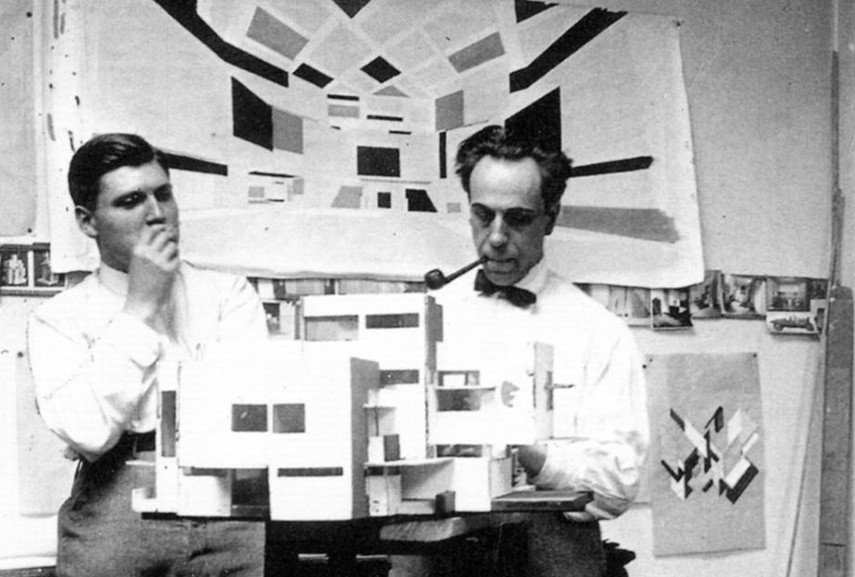
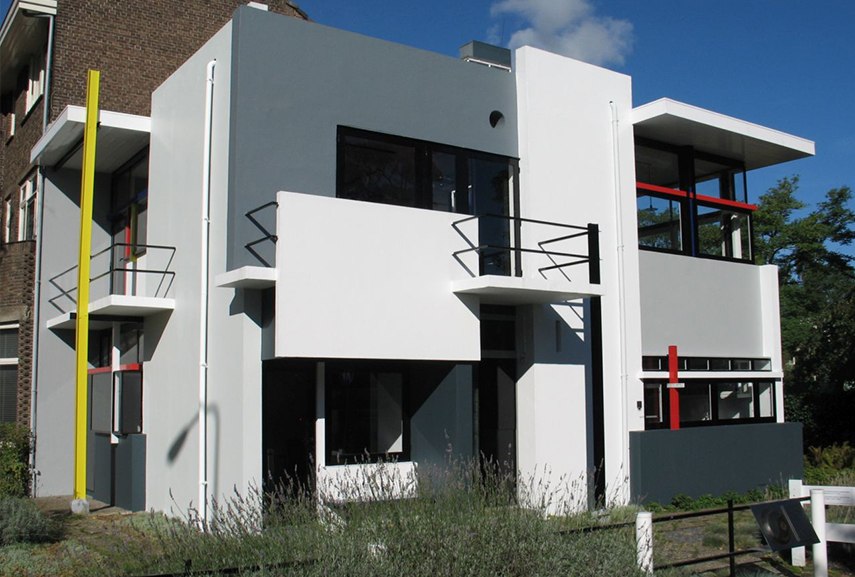
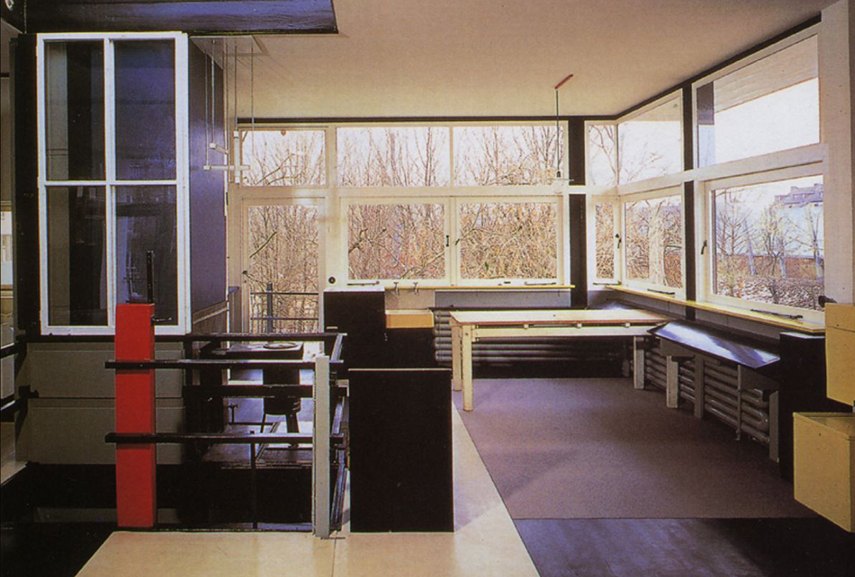
Since the name of the group was, literally, the Style, information technology comes equally no surprise that it was a full way as well. Beside painting and sculpture, information technology made meaning bear on on typography, architecture and pattern, and fifty-fifty music at some point. However, all of these genres were strongly influenced by painting, which is somewhat logical, given that painting could be considered a foundation for other media. De Stijl compages was no exception of course, simply since building takes longer than painting, there are not equally many examples that adhere to the principles of De Stijl entirely. Actually, the only house that is supposedly designed to match all the propositions of De Stijl manifestos is Schröder House by Gerrit Rietveld, who was one of the about famous members of the grouping side by side to the painters Piet Mondrian and Theo van Doesburg. Just fifty-fifty though De Stijl'due south ideas on architecture were non mastered within the group's work during the fourth dimension of their existence, they are a office of a greater moving-picture show that we know as Modern architecture today. It is often emphasized that De Stijl was important for the development of International Style, as they are both based on the thought of a "universal linguistic communication" which seems to be the central point of De Stijl, and one of its most valuable gifts to the Modern globe.
Defining De Stijl Architecture - Towards Total Modernism
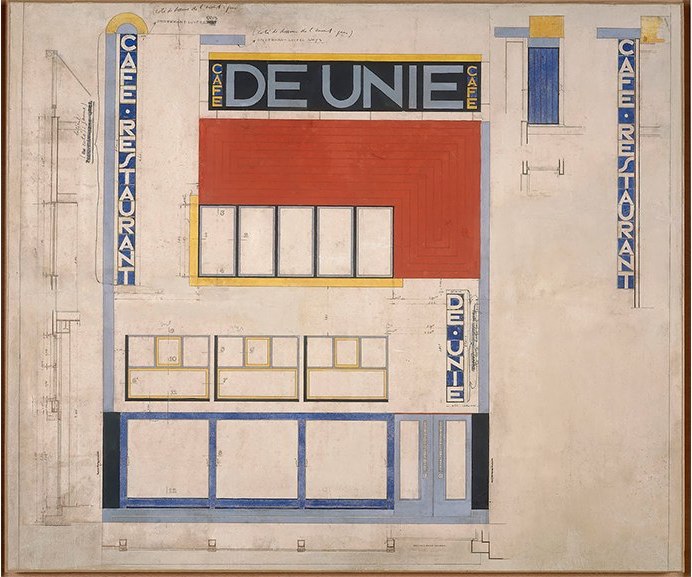
The anti-individualist principles that all De Stijl members aimed to embody through the means of "unproblematic" plastic expression were nowadays in architecture too, meaning that buildings were designed with an awareness of a purified, universal grade. One of the things that make architectural expression different from painting is the beingness of the tertiary dimension, which makes the horizontal and the vertical elements overlap in some plans, and diverge in others, so fifty-fifty though the facades were often reminiscent of Mondrian's paintings, the limerick was arranged beyond infinite. The other affair is utility of grade, which introduces the 2d most important characteristic of De Stijl compages. Since De Stijl was one of the pioneers of the Sullivan-derived form-follows-function practice, most of the things you know well-nigh mod architecture applies to De Stijl architecture equally well. It was, yet, preceded past the designs of Frank Lloyd Wright, whose influence on De Stijl assisted the formulation of this architectural form to a swell extent. The other important influence comes from Hendrik Petrus Berlage, a prominent Dutch architect whose piece of work is oft regarded every bit an acting stage betwixt traditionalism and modernism in the Netherlands.
Primary Colors and Shapes equally a New Language
Apart from being quite single-minded near the demand to re-articulate architectural form and to salve architecture of ornamentation, the proponents of Neoplasticism were determined about the color scheme as well. Simply blue, red and xanthous were used to outline certain elements of De Stijl pattern, otherwise the surface was painted in white, grayness or black (the non-colors). This was applied both to the facade and the interior of a building, and obviously to piece of furniture pattern besides. On this field of study, Hans Richter, i of the younger members of De Stijl known for his contribution to "abstract movie", wrote:
It has to be emphasized again and again that fine art is not the subjective explosion of an individual, but the organic language of man, of a most serious importance; therefore it is to be equally free from fault and equally concise equally possible, in guild to be really used as such: as the language of humanity. For this new art it is absolutely necessary to dispose over definite elements. Without these a (well-nigh attractive) game can be brought near, but never a language.
Statements like this, and the full general approach of De Stijl made information technology vulnerable to numerous (mis)interpretations. Only like the majority of Modern fine art movements, De Stijl was fighting to find an equilibrium betwixt being sectional, or even extremist, and advocating universality and global equality.
De Stijl Architects and Their Legacy
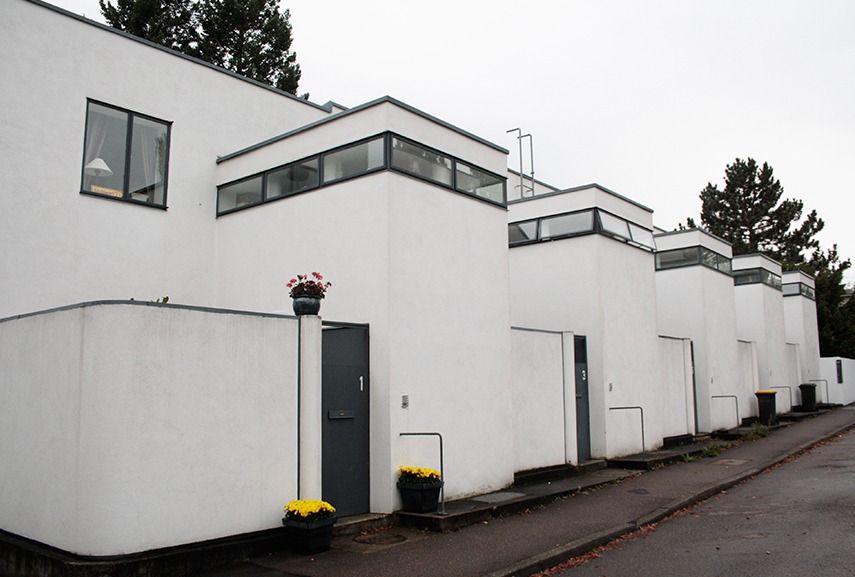
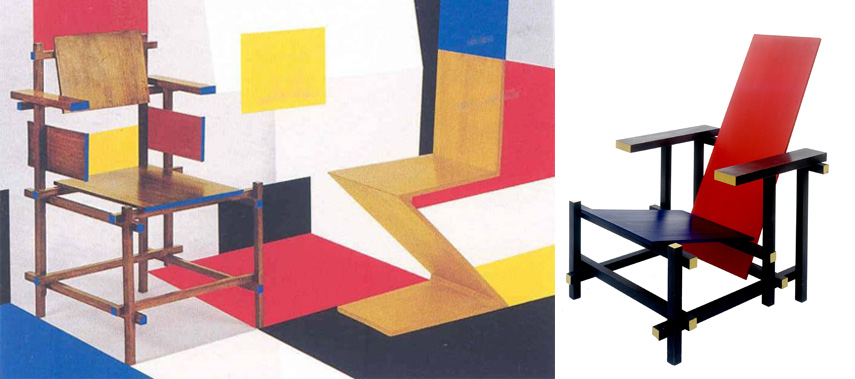
Three names are nearly instantly associated with De Stijl architecture: Gerrit Rietveld, the aforesaid writer of Schröder House, J.J.P. Oud, who coined a cute term "poetic functionalism", and Robert van 't Hoff, whose Villa Henny was one of the first modernist houses e'er built, in 1914. Robert van't Hoff'south villa was also the very first house that was built out of reinforced concrete, which basically redirected the development of architectural design. All three of them were famous for their industrial designs as well, whereas Rietveld's Cherry-red and Blue Chair is possibly one of the most iconic pieces of furniture ever made. Interestingly, information technology was fabricated the same twelvemonth that the manner was officially announced (1917). A lot of De Stijl's artists, but especially architects, found an adequate surrounding for their activities in Weimar, among the circles of the Bauhaus in 1921. Two groups were very much akin in many aspects, and their mutual influence gave meaningful results, both for the Bauhaus and De Stijl.
Interestingly, two of these eminent architects, Oud and van 't Hoff were quite successful in the menstruation of De Stijl'southward first years, but in the 1920s they both decided to choose different paths. Oud spontaneously decided to withdraw in 1921, simply he continued working in a like manner, up until the 40's when he was condemned for his supposed return to ornamentation. Nonetheless, Oud is still considered to be one of the nigh important Modernist architects. Robert van 't Hoff'due south resignation was far more definitive, equally he decided to get out the group in 1922 and became a self-proclaimed ex architect, which marked his final break-up with the discipline and from any kind of artistic date. He subsequently became involved in anarchistic activities.


Founded in the Netherlands in 1917, the name De Stijl belonged to a mag. Today, we employ it to define a very specific art grouping, which connected the abstruse at and functional compages through the work of its major representatives: Mondrian, Van Doesburg, Van der Leck, Oud, Wils and Rietveld. This volume is the beginning to place the emphasis on the local context of De Stijl and explore its relationship to the distinctive character of Dutch modernism. The connection between debates concerning abstraction in painting and spatiality in architecture are examined, likewise as the contemporary developments in the fields of urban planning, advertisement, interior design and exhibition pattern. From a historical perspective, the book explores the relationship and the interaction betwixt the world of mass culture and the fine arts.
Mondrian and His Theory of Abstruse Art
Nosotros take a 'nostalgia for the universal' wrote Piet Mondrian. 'This nostalgia must bring forward a completely new fine art'. This betoken of view, of searching for the new form of artistic expression, marked the 20th-century fine art and major Avant-garde movements that sprung during this period. With this in mind, we need to consider the importance Mondrian left; non only in his legacy of paintings and design concepts but more importantly every bit one of the artist-metaphysicians of our time, we demand to acknowledge his views regarding the artistic language and his philosophical reflections. Every bit one of the founders of the Dutch style De Stijl, the artist was recognized for the purity of brainchild and methodical practice by which he arrived at it. The harsh reduction and simplicity of his non-representational art, which he named neoplasticism, hides a more mystical approach to the world. Mondrian's paintings reflected what he saw as the spiritual order underlying the visible earth, and equally such, his art, needs to be viewed as a symbol, possibly improve to say a sign, of the universal aesthetic language.
The Early Phase of Mondrian'south Art
Piet Mondrian and his contemporaries wrestled against the past and this rebellion continued long afterwards the initial human activity of self-liberation to sound the alarm against tradition. Even so, his early paintings, influenced by the choice of field of study matter and arroyo to colors imposed by the Impressionism, more than importantly, Mail-Impressionism masters such as Vincent Van Gogh and painting technique of Georges Seurat, show a degree of abstraction only they are in most cases marked equally Naturalistic and fall under a category of landscape paintings.
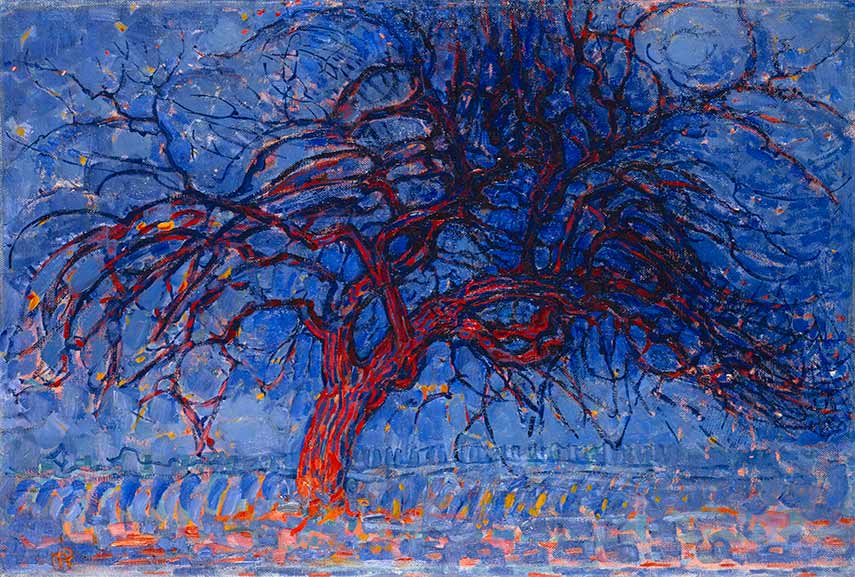
The early pastoral paintings of his native country, the netherlands, depict windmills, fields, and rivers, and they besides assistance to illustrate a variety of influences a number of art movements, such as Pointillism and Fauvism had on Mondrian. Information technology is his painting Evening: Red Tree that seems to propose his later development towards geometrical abstraction and his utilise of chief colors. These series of canvases from 1905 to 1908, depicting dim scenes of trees and houses reflected in nevertheless water, echo Mondrian'due south ideas and the accent on form over the content. Even though these paintings are nonetheless decisively rooted in nature, for all of us familiar with the artist's later achievements, nosotros are almost trained to search for and discover evidence of his hereafter abstraction.
The Fusion of Spirituality and Cubism
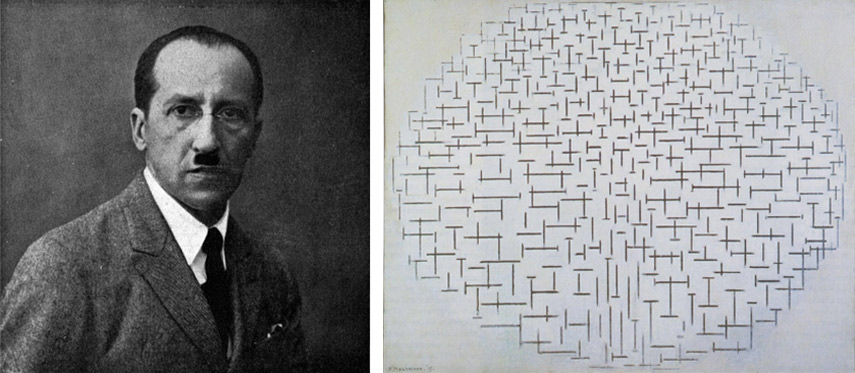
The move to Paris in 1911 marked the beginning of the style we take all come to acknowledge as the style of Mondrian'southward Art. The strong defiance of the linear perspective and the emphasis placed on the flatness of the surface, alongside the geometric shapes and interlocking of planes of Cubism, visible in the practice of Picasso and Georges Braque , was almost immediate in Mondrian's artwork. Merely, where did he differ? The major difference betwixt Mondrian and the Paris advanced lies in the fact that with his art Mondrian from the first attempted to reconcile or fuse together the art and the mystical. His paintings and his writings, which reflected his theories well-nigh art, spirituality, philosophy, and the new look and expression of the natural universal laws, were with him from the beginning. Prior to coming to Paris, in 1908 he joined the Theosophical Society, a spiritual arrangement based on the teachings of Buddhism. Mondrian said:
All the time I'm driven to the spiritual. Through Theosophy, I became aware that art could provide a transition to the effectively regions, which I will call the spiritual realm.
The mystical, the intuitive, the universal, the need to attain pure harmony, all of this Mondrian attempted to express in his artwork that was gradually condign more and more abstract. What he aimed to express was the spiritual energy and the balance of forces that ruled nature and the universe, and to this desire we owe the simplification of nature to horizontal and vertical lines, which represented the two opposing forces: the positive and the negative, the dynamic and the static, the masculine and the feminine.
Mondrian and De Stijl Perspectives
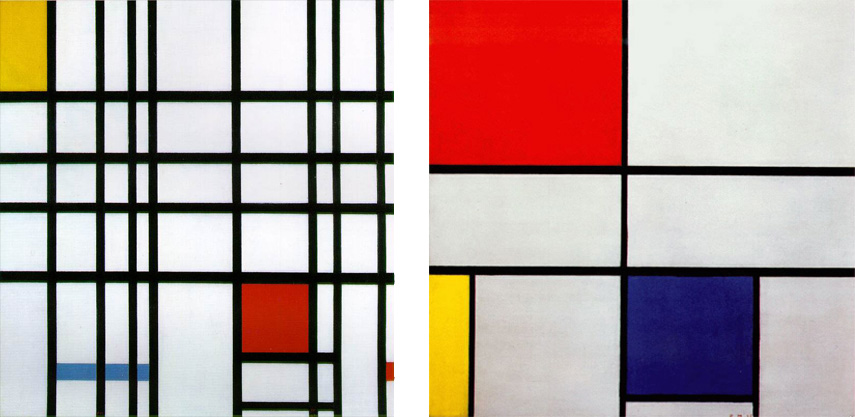
In 1913 Mondrian began to fuse his art and his theosophical studies into a theory that indicated his terminal suspension from representational painting. It was also during this time, that the artist needed to return back home, but the flare-up of the World War I forced him to stay in Netherlands during the brutal conflicts. While at habitation he met Bart van der Leck and Theo van Doesburg. The ii artists were also attempting to reach pure abstraction and the joined forces marked the beginning of De Stijl. Advocating the pure brainchild and a pared down palette of colors in society to express a Utopian ideal of universal harmony in all of the arts, De Stijl was a major avant-garde motility emphasized abstraction. They believed that their vision of modern art would transcend divisions in civilization and become a shared linguistic communication based on the primary colors and flatness of forms. The simple geometrical shapes and the grid lines hid metaphysical ideas of universal laws that Mondrian attempted to explain in his famous publication on abstract art The New Plastic in Painting. The plastic in the title and in the name of the new form of art referred to the new way of representing reality found upon the surface of the artwork itself. This newfound abstraction and the need for a universal linguistic communication reflected itself in the hereafter titles of his painting that were ofttimes named and labeled purely as Compositions.
It was due to his utopian ideals and understanding of the representational quality of abstraction that Mondrian is viewed every bit one of the important artists that helped the development of modernistic art. While he was even so alive and even after his decease the impact of his thoughts and paintings was influential. Almost immediately he was referenced past the Bauhaus , and later in the Minimalists of the belatedly 1960's. His paintings continued to develop but they remained faithful to his views that nature and its hidden dynamic forces are all-time described with the apply of lines, grids, and primary colors. Where the lines met, the magic and pure forces of nature were expressed.


This book explores the work of Mondrian, one of the keen innovators of abstract art. The focus is put on the assay of the interrelations between his paintings and the theory of art he professed, paralleled with his views on life, taken from the public writings and mainly unpublished letters. More intuitive than mathematical, Mondrian's art was not based on reasoning or calculation, as the artist e'er strove to provide the wider cultural and philosophical context for information technology. Critical to Mondrian'due south thought was the Theosophical notion of evolution, which required the destruction of the old to make room for the new, in life, in gild and in art.
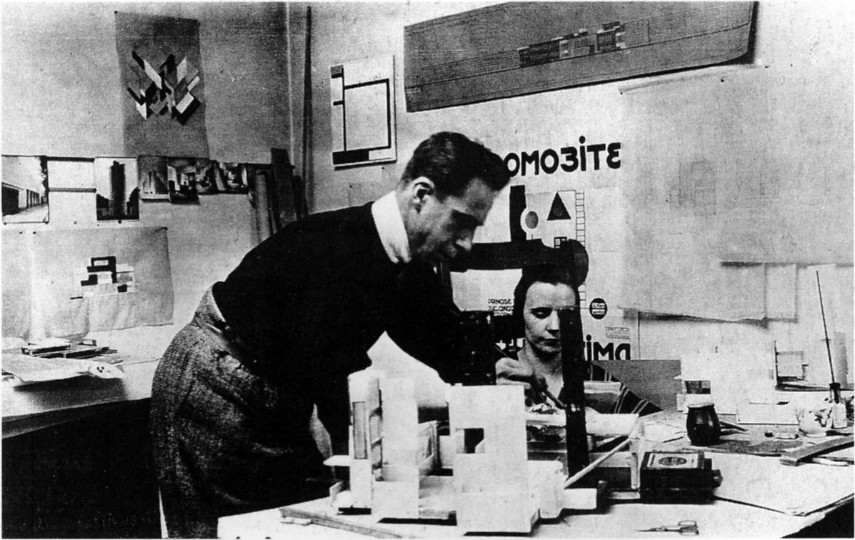
Famous De Stijl Artists
Apart from the founding members of the magazine De Stijl that announced the emergence of the new fine art movement, the search for laws of equilibrium and harmony applicable both to art and life that De Stijl stood for, has attracted many prominent artists and architects of the time. The work of architects associated with De Stijl has helped give rise to the International Style of the 1920s and 1930s. The ultimate simplicity, abstraction and the color theory of De Stijl have influenced many artists that followed, from Max Ball to Mark Rothko. Piet Mondrian is certainly the most famous creative person associated with the grouping, but let's take a look at other prominent names that contributed to this grouping profoundly.
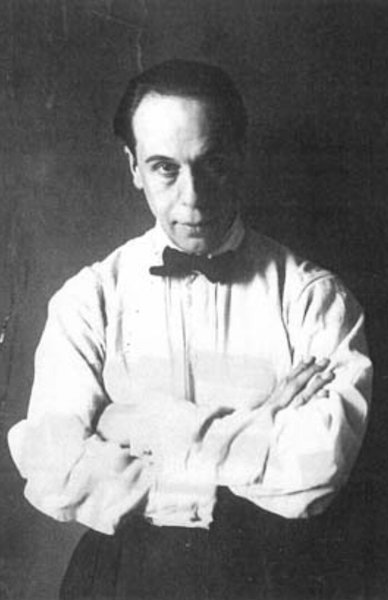
Theo Van Doesburg
Afterwards coming in contact with the works of Piet Mondrian, Theo Van Doesburg saw these pieces as the ideal in painting as a consummate abstraction of reality. With Mondrian and other prominent figures of the move-to-be, he founded the mag De Stijl in 1917. As an ambassador of the move, he promoted it all across Europe. He created numerous abstract paintings and designed buildings, room decorations, stained glass, furniture and household items in a simplified geometric artful that De Stijl advocated. The manner that emphasized subtle shifts in tones, tilted geometric shapes and colored directly and disconnected lines, became his own version of De Stijl called Elementarism. The multifariousness he wanted to infuse in the movement led to the split with Mondrian in 1924. For him, brainchild had a unique quality to accomplish social order and harmony.
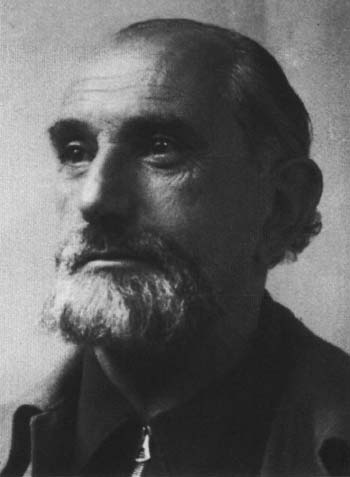
Vilmos Huszar
Hungarian-born painter and designer, Vilmos Huszar has lived in Netherlands and was i of the founding fathers of De Stijl. He designed the cover for the first result of the magazine De Stijl and contributed greatly to defining the Neo-Plasticism with numerous articles. While involved in the movement, he produced diverse abstract works, industrial and commercial graphic works, and collaborated on numerous interior pattern projects such as for the home of the industrialist Bruynzeel. Additionally, he designed furniture with Piet Zwart from 1920 to 1921. Later the outbreak of the World State of war II, he moved to the minor Dutch town of Hierden where he painted the landscape around him. Since 1955, he was focused on finding a pure non-objective language.
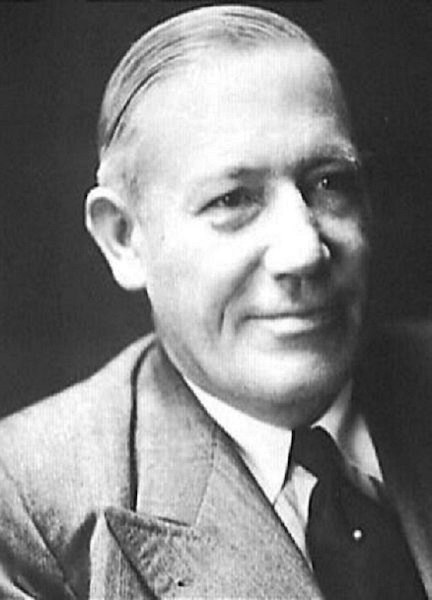
Jan Wils
The Dutch architect January Wils was another founding member of the De Stijl. His designs had a sleek shape with the accent on horizontal and vertical lines, but were besides very vital and organic. One of his most notable works is the Olympic stadium for the 1928 Summer Olympics in Amsterdam that has also won the aureate medal in the Olympic fine art contest. He worked on several projects with Van Doesburg before their split in 1919, including the refurbishment of the now demolished eating place Dual Key in Woerden. After designing the housing complex Papaverhof in The Hague, he became deeply interested in problems of urban housing. Other important works are the Citroën garage and the City Movie theatre in Amsterdam, the Mutual part in The Hague and the Bouwes hotel in Zandvoort.
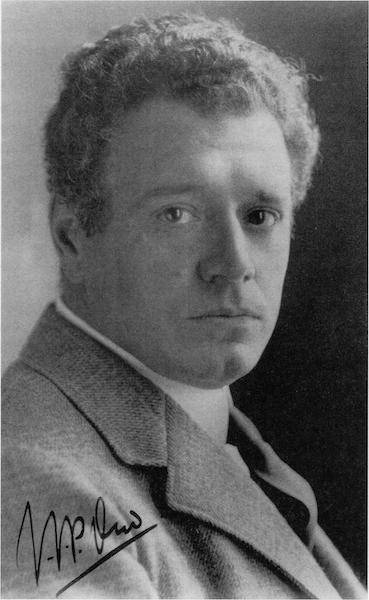
J. J. P. Oud
Jacobus Johannes Pieter Oud, usually called J. J. P. Oud, was a Dutch builder that got involved with the motility in 1917. He was appointed Municipal Housing Architect for Rotterdam between 1918 and 1933. Working mostly on socially progressive residential projects around Netherlands, he is now best known for his remarkable works for housing schemes in expanding areas. Trying to reconcile strict and rational construction technique with necessities and artful expectations of the residents, he practiced 'poetic functionalism'. Thus, he is considered a pioneer of the Dutch Functionalist architecture. From 1932, he was considered one of the four best modern architects along with Ludwig Mies van der Rohe, Walter Gropius and Le Corbusier. He abandoned De Stijl influences subsequently the Globe War II, but continued to rebel confronting the mainstream modernism.
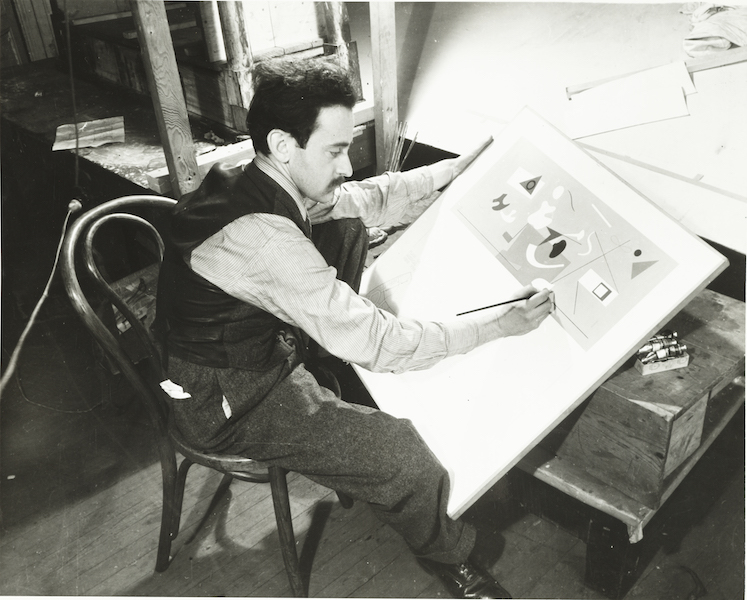
Ilya Bolotowsky
Russian-born painter Ilya Bolotowsky was a student of Piet Mondrian who has made a significant contribution to the American geometric abstraction. After completely adopting Mondrian's geometric patterns and a palette restricted to primary colors and neutrals, he co-founded American Abstract Creative person collective that promoted abstraction and these artists to the public. These neo-plastic paintings characterized his piece of work throughout his career. He created the mural for the Williamsburg Housing Project in Brooklyn that was the showtime mural deputed by the Federal Art Project. He always emphasized the part of the intuition over formula regarding his compositions. He also joined the artist commonage The 10 along with Adolph Gottlieb and Mark Rothko that advocated for new forms of abstraction and rejected the institution.
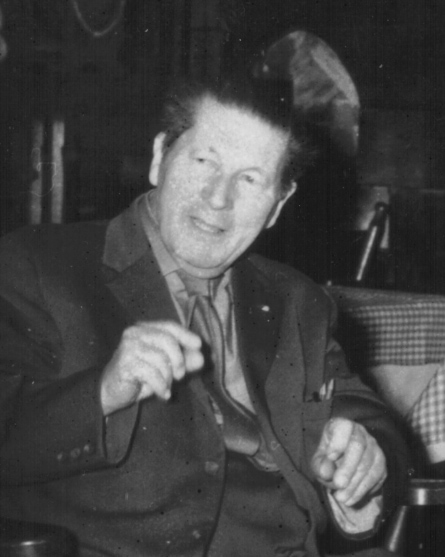
Gerrit Rietveld
Dutch furniture designer and architect Gerrit Rietveld was one of the primal members of De Stijl. His most famous slice was the Red and Blueish Chair from 1917. He aimed for simplicity in his designs and hoped his piece of furniture would exist mass-produced. After getting involved with the De Stijl motility, he started exhibiting worldwide. The starting time building he designed was Rietveld Schröder House in 1924 that looked like a iii-dimensional Mondrian painting and became a UNESCO World Heritage Site in 2000. It has a conventional ground floor simply the radical tiptop floor had sliding walls that could create and change the living spaces. After abandoning De Stijl in 1928, he started designing buildings in a more functionalist way. The Van Gogh Museum in Amsterdam that he started working on in 1934 was finished after his decease.
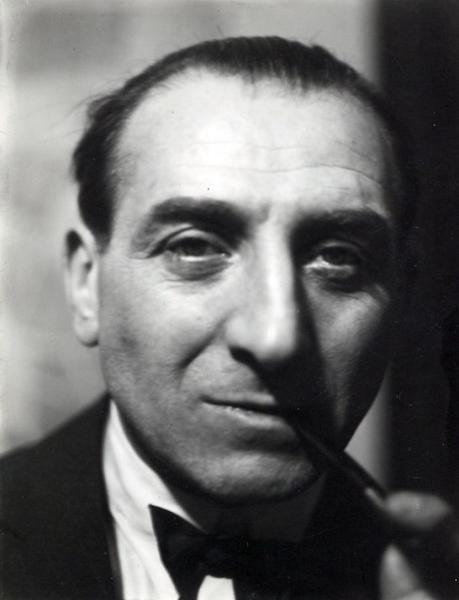
Georges Vantongerloo
The Ditch architect and theorist Georges Vantongerloo has collaborated on the magazine De Stjil with other leading figures of the motion. He was also involved with abstruse painting and sculpture. Often writing for the mag, he formulated his theories about art and the function of the artist that revealed his conventionalities in brainchild and preferences for mystic and scientific theories and concepts. After moving to Menton in France, he associated with the artist and architect Max Bill who has organized many of his exhibitions. In that location he has developed a color theory where he exchanged three primary colors by De Stijl artists with 7 master colors of the spectrum. For him, art, scientific discipline and the society should exist a homogeneous social unit and together benefit the world.
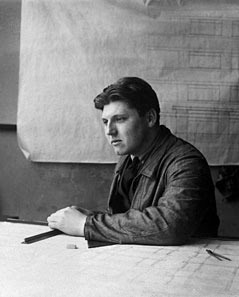
Cornelis van Eesteren
The architectCornelis van Eesteren met Theo van Doesburg in 1923 and the aforementioned year they have created the manifesto Vers une construction collective. He collaborated with January Wils on his infamous design and structure of the Amsterdam Olympic Stadium. He was one of the most prominent urban planners in Netherlands. His work was rooted in the social context. His approach was to identify social issues that needed for spatial solutions. Despite having a certain preconceived formal idea, he would ever let it to grow and change during his work. His name is tightly associated with the 'functional city' concept that was evident in the General Extension Program for Amsterdam he devised in 1929. Based on the statistical forecasts of population growth, he calculated the requirements for housing leisure, employment and traffic.
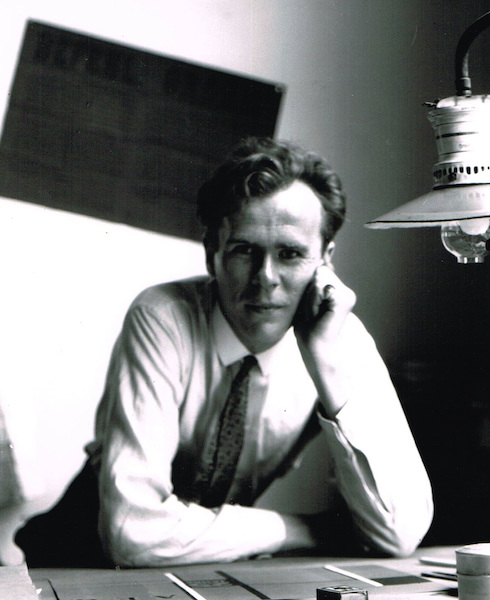
César Domela
Becoming the youngest member of the group in 1925, Cesar Domela's work within De stijl involved several mediums. Due to rigid rules, he quit the group and incorporated the diagonal line and subsequently the third dimension. From and so on, his focus was on three-dimensional reliefs in which he would frequently comprise pieces of Plexiglas and metal as well as photomontages and newspaper cutouts. He adhered to the Ring Neue Verbege stalter founded past Schwitters that gathered artists such as Lissitzky, Heartfield, Moholy-Nagy and Hans Richter. He widely experimented with typography and produced various advertisements in Germany. He designed covers for various anarchistic books, but was forced to destroy them all during the Nazi authorities.
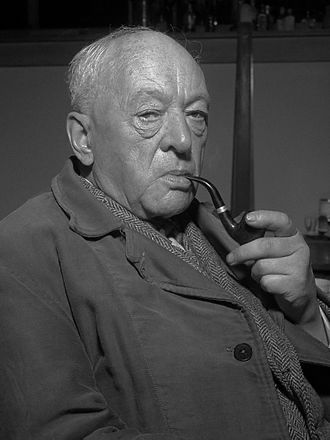
Bart van der Leck
The Dutch painter, designer and ceramicist Bart van der Leck was one of the founding fathers of the motion. From then on, his style became completely abstruse, but after the carve up with Mondrian, this fashion was based on representational images. He claimed to be the father of the avant-garde motility and he recalled his get-go meeting with Doesburg: 'When Doesburg noticed an abstract painting correct on the easel, he exclaimed: 'If that is to be the painting of the future, may I be hanged right at present!' Well, a few months later, he was painting in precisely that style. That'southward the sort of person Doesburg was. No ideas of his ain. And a cheat in deal'. His afterwards works involved carpet designs, fabric and ceramics and the awarding of color in relation to compages.
De Stijl Influence on Art and Design
The essence of De Stijl was finding a new fine art class that could be functionally applied within the order. The pared-downwards aesthetic centered around the apply of the basic visual elements such as geometrical forms, horizontal and vertical lines, and the use of primary colors along with blackness and white. This reduction and simplification, as discussed in the part of this article concentrating on ideas of Piet Mondrian, suggested a need and a desire for the creation of a universal visual language appropriate to the modernistic era, applicable both for fine and applied arts. Partly a reaction against the decorative excess of Art Deco, De Stijl too emerged in response to the horrors of World War I and from the wish to remake the society. For the almost important De Stijl artists, the newfound simplicity, the Neoplasticism, was a means of social and spiritual redemption.
The Importance of Theory
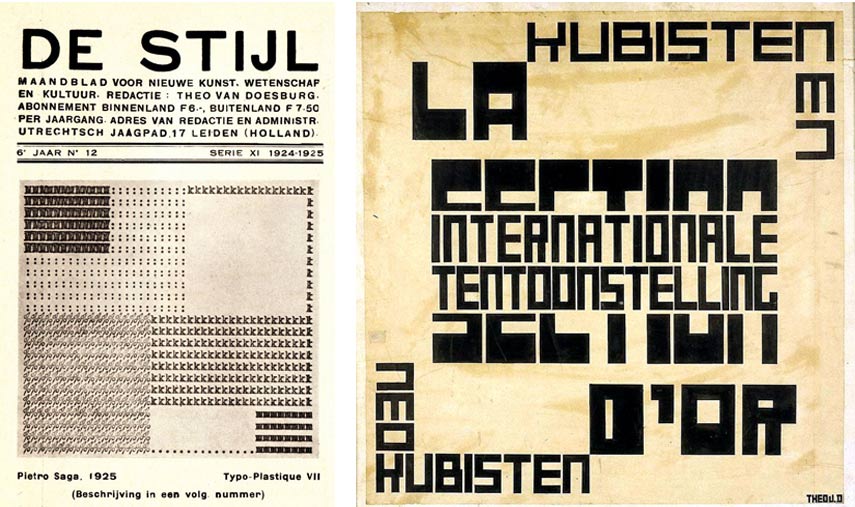
Although De Stijl'southward artists were non the start to practice abstruse art, other painters, perhaps near notably Wassily Kandinsky, Kazimir Malevich and Hans Arp, had earlier created not objective art, De Stijl promoted their views of a more pure abstraction in the first-ever journal devoted to abstraction. This publication, promoting functionalism and incorporation of all fine art forms, represents the nigh significant work of graphic pattern. Published by van Doesburg, the journal promoted the philosophical views of the group, and the famous text by Mondrian Neo-Plasticism in Pictorial Art was specially endorsed.
It was due to De Stijl art and the strong link between theory, concepts and ideas, promoted by Mondrian, who kept journals and often wrote his concepts downwardly, that we tin understand the 'hidden' message behind the grids and geometrical shapes. They stood as symbols, and the desire starting time and foremost as a tool that breaks away from tradition and helps to reshape the new society. These utopian ideas transformed easily onto Bauhaus school and philosophy . The pure non-representational art, simplified lines and colors of Mondrian's paintings were hands referenced in the schoolhouse's aesthetic. This simplicity but above all the focus on functionalism was also promoted in practical arts near especially in furniture design. The famous chair by Gerrit Rietveld was fashioned in the same Neo-Plastic or De Stijl style visible in the paintings of the motility's artists. The chair affects the focus on functionalism equally much equally the practicality of awarding. The focus of the group, equally discussed to a higher place, entered into different areas of art, such every bit typography, article of furniture design, graphic design, and followed closely with the notion, put forward past the English designer William Morris, of the fusion and the break of the hierarchical system between fine and applied arts.
De Stijl Typography and Posters
Out of all the avant-baby-sit movements, De Stijl art had i of the virtually immediate impacts on typography . The principles of their non-representational fine art were applicative and put to utilise forming a new geometrical experience of the letter of the alphabet. The need to make the letters fill up the shape of the square acquired a variety of deformations and rough distortions in the alphabet created by Theo van Doesburg. The asymmetrically balanced layout of the artist's typography and poster pattern was given harmony and dissimilarity by the juxtaposition of dissimilar letter thickness along with the use of black and white color, orthogonal lines leaving out whatever evidence of cocky-expression.
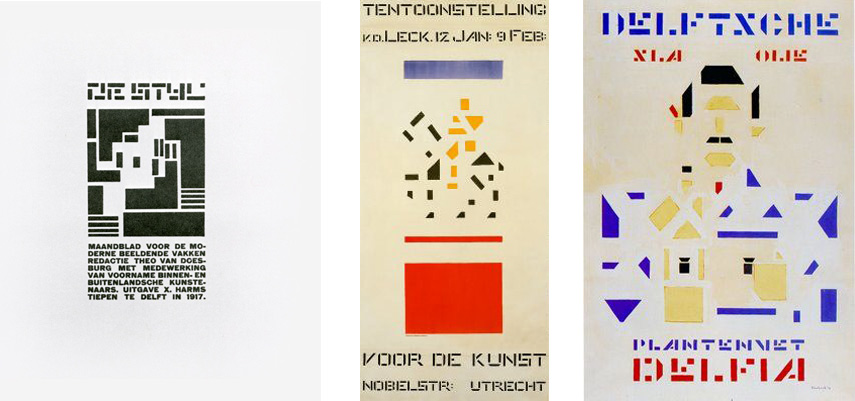
Every bit much equally the art product focused on order and balance, the graphic blueprint piece of work, encompassing the mentioned typography design, influenced also book and poster designs. A variety of commercial affiche designs were done by authors of this movement. In 1919 Bart van der Leck created a affiche pattern for Delft Salad Oil Factories. In this affiche the figure along with text was suggested by very basic geometrical shapes, using only principal colors. The outline of the figure was completely left out and the scattered objects described the figure. This is perhaps one of the most interesting examples of De Stijl commercial blueprint works. Transforming their ideas of color, the dominance of the carmine color, evident in the various examples, was explained beginning and foremost through the symbolic force of the color, closely linked to revolution and its powerful effect with the black colour.
The Legacy of Neoplasticism
The De Stijl's artists securely believed in their ideal sense of order equally a response to the trauma of the World War I. Afflicted by the notion of globalization instead of individualism, they tried to express their ideas and produce works of fine art that are both mystical and functional. The simplicity of their designs influenced many artists that followed, such equally the monochromatic paintings of Newman and Reinhard, which lack any bear witness of cocky-expression. The flatness of the surface and its manipulation past color and grid lines, some link to the nascence of Op Fine art , the motion that concentrated on the surface dynamics that create visual effects designed to misfile the eye. The progress made in graphic design works focused on the reduction of objects, letters, and figures to basic geometrical shapes was referenced past Bauhaus's typography designs, contemporary art, design and architecture as well. Out of the rebellion towards the past and the pure desire for a better future, the artists of this movement reshaped not only their time simply helped to ascertain the fine art we know today.


The essential book on the Dutch mod art movement, De Stijl by H. L. C. Jaffé tells the history of the style and the group, explaining its practice and its ideas, outlining its utopian ideology, while analysing the particular traits of the neoplastic painting, sculpture, architecture and design. The author maps the evolution of the art move from its foundation in 1917, with the emergence of the eponymous journal De Stijl. The volume reveals the philosophical background of the artistic practice, which casted away the figural and the representational and limited itself to the purity of class and expression. The basic vertical and horizontal lines juxtaposed with the primary colors make the cardinal visuals of De Stijl, widely recognized every bit such even today. With its main representatives van Doesburg and Mondrian, the move spread from painting into design and compages and sculpture as well, adopted by Jean Art or Constantin Brancusi. Contextualizing De Stijl in terms of its abstruse nature, the writer concludes on its influence.
Written by Natalie P, Silka P and Elena Martinique.
Featured images: Piet Mondrian - Piet Mondrian - Composition Ii in Red Blue Yellow; Piet Mondrian - Tableau I; Theo van Doesburg - Counter Composition V. All images used for illustrative purposes only.
Source: https://www.widewalls.ch/magazine/de-stijl-neoplasticism

Postar um comentário for "Color Guard Stained Glass Road Insiide of a Circel Art"